What we work on
We develop learning-enabled optimization and control methods for complex dynamical systems. Our work connects mathematical structure, differentiable computation, and physical models to make intelligent systems faster, safer, and useful at scale.
Core methods
Learning to Control & Optimize
We build learning-based policies and optimization methods that make high-dimensional decision problems fast enough for real-time use while retaining the constraints and structure that engineering systems demand.
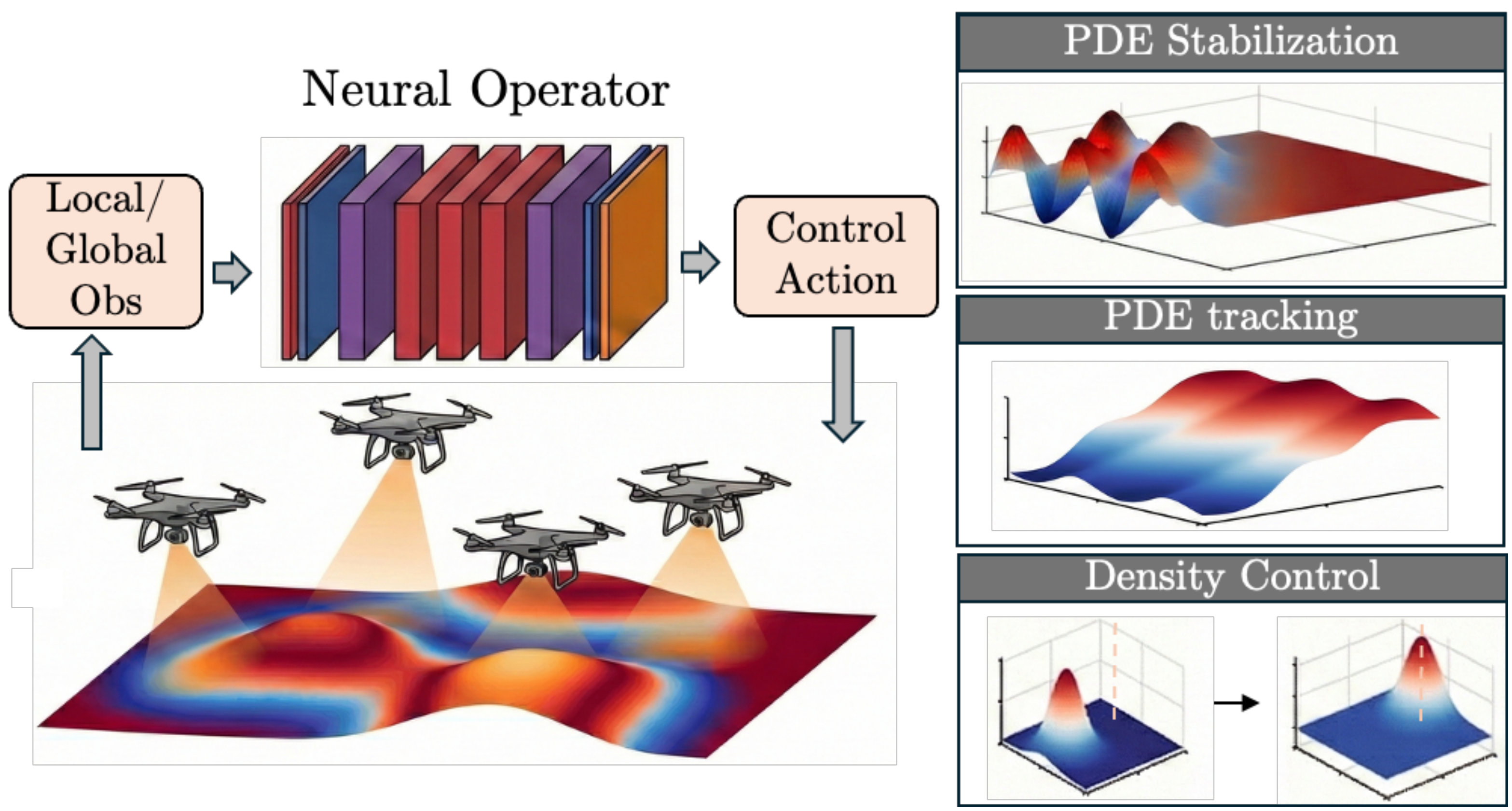
Our research combines differentiable predictive control, learning to optimize, neural operators, and end-to-end physical simulation. The goal is not only to predict what a system will do, but to learn decisions that control it well.
- Differentiable predictive control
- Constrained learning to optimize
- Neural operators for distributed systems
Optimization algorithms
Real-Time Optimization & Model Predictive Control
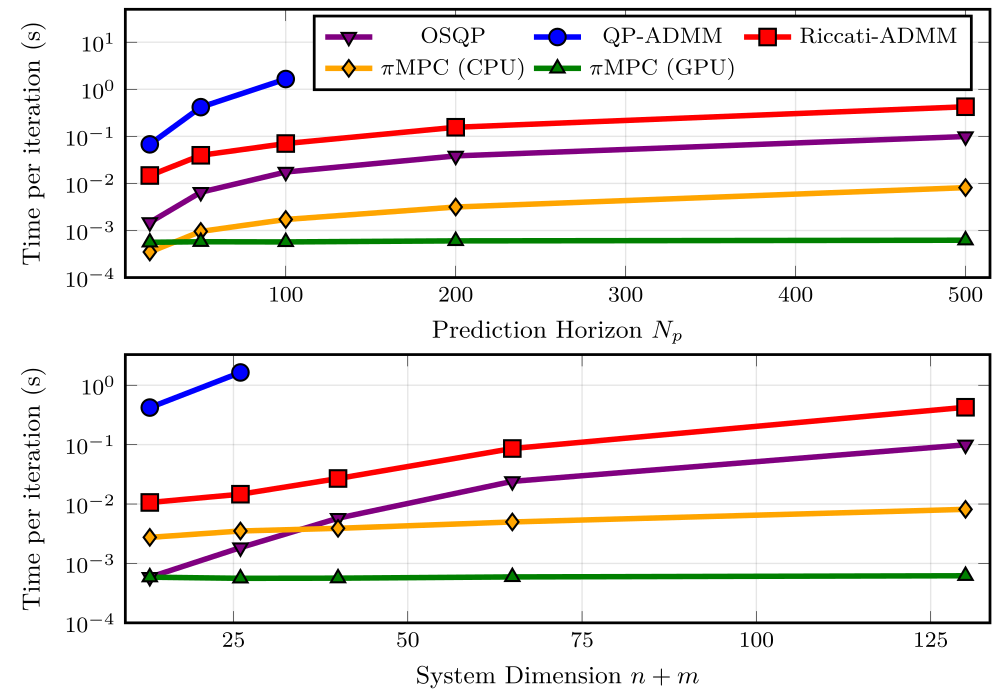
We design optimization algorithms that make model predictive control fast, scalable, and dependable enough for demanding real-time systems. Our methods exploit problem structure and modern parallel hardware instead of treating the online optimization problem as a black box.
This direction spans parallel-in-horizon and construction-free MPC solvers, execution-time-certified optimization, and Koopman-based predictive control. The goal is reliable closed-loop performance even for long horizons, nonlinear models, and embedded implementations.
- Fast and parallel MPC solvers
- Time-certified optimization
- Koopman-based predictive control
Systems and impact
Control for Energy Systems
We translate advances in learning and control into practical tools for sustainable energy systems. These applications bring together nonlinear physics, uncertain operating conditions, discrete decisions, and strict real-time requirements.
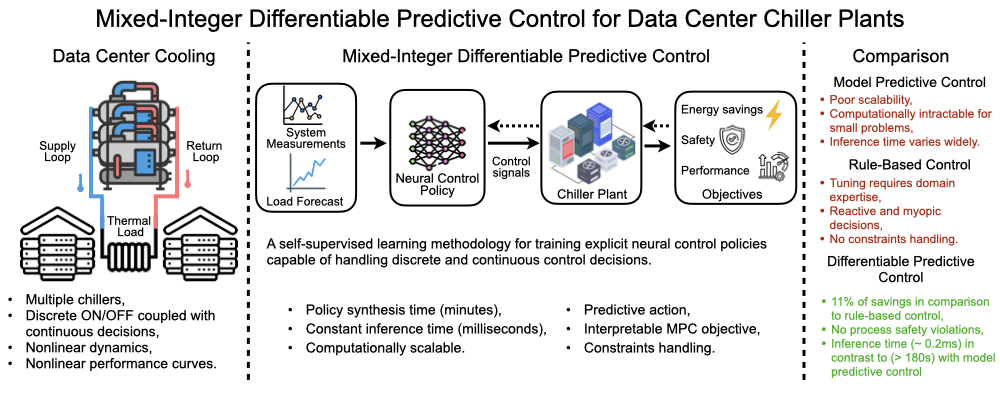
Our work covers grid-scale energy storage, batteries, buildings, HVAC systems, and data-center cooling—using learning-enabled optimization to operate them efficiently without losing sight of physical feasibility.
- Grid-scale storage and battery dispatch
- Buildings, HVAC, and data-center cooling
- Mixed-integer real-time control